Compare the offers. Justify each choice.
IT services, outsourcing, document management, or claims management services: compare the offers received using a single common grid. Specgen produces analyses and proposed scores, with their sources, to support the decision-making of your procurement and business teams.
Procurement, business, IT, risk, and compliance departments · Banks and insurance companies
The selected criterion is applied to all three offers.
The analysis refers to the available excerpts; the proposed scores should be reviewed.
Specgen prepares the clarification; sending remains with your team.
Explanatory diagram · Fictional example, with no customer data.
A solution tailored to the way you work.
A common grid
Candidates respond in different structures, with varying levels of detail.
Items to complete
A response on reversibility, service commitments, or the continuity arrangements must be reviewed.
Well-founded assessments
Procurement, business teams, and control functions must be able to review the elements that support the comparison.
Data under control
The consultations and offers received contain sensitive commercial and operational information.
A comparison your teams can explain.
The criterion-by-criterion analysis and the proposed scores are linked to the elements available in the offers. Teams can review the justifications, prepare clarifications, and keep a record of their decisions.
Your tendering AI.
In your environment.
A three-month discovery is also possible On-Premise or Air-Gapped , after installation in your environment. Operation without an outbound connection can then be evaluated with your technical teams.
More time for expertise and decision-making.
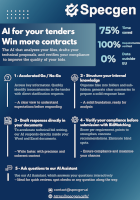
Compare responses using a common grid despite different document structures.
Support candidate discussions with the documentary points that still need to be clarified.
Make the assessments, the proposed scores, and their sources available to the evaluators.
Questions to review for your project.
AI suggests scores and well-founded assessments. Evaluators review them and remain responsible for the final decision.
Local processing helps maintain control of data. Your organization’s requirements and the applicable obligations still need to be reviewed by your competent functions.
Let’s shed light on your next comparison.
Let’s discuss your use cases with the people involved in your project. A one-hour video demo, with no prior preparation.
Request a demoAn old file can be used as supporting material under an NDA. The AI results are presented back to you on a timeline agreed based on the teams’ availability.
The answers to move forward.
How does Specgen compare multiple supplier bids?
Bids are analyzed using the same criteria grid. Specgen produces an analysis by criterion and a comparative summary, with the source excerpts available.
Does the AI assign scores?
Yes, Specgen provides scores and assessments. They are reviewed by your evaluators; the final award decision remains human.
Does Specgen send questions to bidders?
No. Specgen helps prepare and track follow-up questions. Sending them is handled by your team as part of your consultation process.
Does an unlocated response mean that the bidder did not respond?
Not necessarily. This status indicates that a response was not located by the analysis. Your evaluators review the offer and request clarification if necessary.
What use cases for an insurance company?
Procurement teams can compare offers from IT service providers, document management providers, or claims management services, based on their criteria and the documents received.
Can we try Specgen for three months on our infrastructure?
Yes. The three-month discovery can be carried out On-Premise or Air-Gapped, after installation in your environment. Discovery on servers in France is also possible for non-sensitive cases suited to this framework.
How can we verify the sources of the AI’s results?
Requirements, drafted passages, and assessments are linked to their documentary sources. Specgen flags insufficient information; your teams review the supporting evidence and validate the results.
 Specgen