Every requirement matters. Give them a sourced answer.
Technical specifications, quality appendices, contractual terms: structure the requirements of your tenders and prepare your responses based on your knowledge. Your experts remain in control of commitments, your data stays within your infrastructure.
Bid management, engineering, and quality · Equipment suppliers, service companies, and energy stakeholders
Each line retains its document reference.
The team checks the applicability of the methods and references.
Your experts arbitrate and validate the commitments before submission.
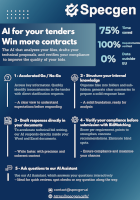
Explanatory diagram · Fictional example, with no customer data.
A solution tailored to the way you work.
A structured reading
The requirements are distributed across the specifications, its appendices, and the tender tables.
Expected items to address
Your response must set out the methods, skills, and supporting documents requested by the client.
Your expertise reused
From equipment to engineering services, the relevant references differ for each tender.
Justified commitments
The review brings technical, quality, and sales teams together around the same proposal.
A bid review that traces back to the source.
BidMatching compares the offer against the extracted requirements. Your teams distinguish between covered, partial, missing, or not assessed responses and have the excerpts that justify the analysis.
Your tendering AI.
In your environment.
A three-month discovery is also possible On-Premise or Air-Gapped , after installation in your environment. Operation without an outbound connection can then be evaluated with your technical teams.
More time for expertise and decision-making.
A single workflow to understand the tender, reuse knowledge, and draft the response.
Classified requirements and accessible sources to focus the review on commitments.
Methods and references reused according to the actual scope of each new service.
Questions to review for your project.
Specgen provides them with a structured, sourced working basis. The interpretation of requirements and technical validation remain in their hands.
Energy equipment, maintenance, or engineering bid packages have their own requirements. The documents and knowledge selected determine the content of the response.
See what Specgen brings to your offers.
Let’s discuss your use cases with the people involved in your project. A one-hour video demo, with no prior preparation.
Request a demoAn old file can be used as supporting material under an NDA. The AI results are presented back to you on a timeline agreed based on the teams’ availability.
The answers to move forward.
How does Specgen analyze a nuclear tender?
Specgen analyzes the provided PDF, Word, and Excel documents, extracts and classifies their requirements, then links each requirement to its source. Teams can adjust the type, importance, and tags.
How do you add a supplementary document or an addendum?
You add the document and manually trigger its analysis. Specgen processes the documents provided; it does not automatically detect referenced but missing documents, nor the correct revision.
Does Specgen prepare a quality assurance plan?
The scope presented here is the response to the call for tenders: requirements analysis, drafting the technical proposal, and bid verification. Preparing a quality assurance plan is not part of this promise.
How do you check requirements coverage?
BidMatching compares the bid documents against the requirements and provides a substantiated assessment with the available sources. The submission decision remains with your teams.
Does Specgen guarantee our offer’s compliance?
Specgen provides support for document analysis and verification. Your experts validate the interpretation of requirements, the supporting evidence, and the commitments in your bid.
Can we try Specgen for three months on our infrastructure?
Yes. The three-month discovery can be carried out On-Premise or Air-Gapped, after installation in your environment. Discovery on servers in France is also possible for non-sensitive cases suited to this framework.
How can we verify the sources of the AI’s results?
Requirements, drafted passages, and assessments are linked to their documentary sources. Specgen flags insufficient information; your teams review the supporting evidence and validate the results.
 Specgen