In a technical CCTP for an industrial tender, each specification must be turned into a traceable requirement before drafting the bid. The bidder must identify what is actually being requested, keep the source of each requirement, pass it on to the relevant discipline, and check that it is covered in the response. This method becomes particularly useful when the technical specifications are spread across the CCTP, drawings, appendices, Excel spreadsheets, and the other documents in the tender package.
What is the role of the CCTP in an industrial tender?
The CCTP sets out the technical clauses necessary to perform the services when it forms part of a public contract. Article 2 of the CCAG applicable to public industrial contracts (CCAG-MI, order of 30 March 2021) defines it, like the other 2021 CCAGs, as the contractual document that sets out the technical clauses necessary to perform the services under the contract.
In a private industrial tender, neither the Public Procurement Code nor the CCAG applies. The same role is fulfilled by a technical specification, a client specification, or a technical file, without the document being legally a CCTP. The analysis method described here remains the same in both cases.
Article R2111-4 of the French Public Procurement Code further specifies that technical specifications define the required characteristics of the works, supplies, or services that are the subject of the contract. They may also refer to the production or supply process or method, provided that they are linked to the subject matter of the contract and proportionate to its value and objectives.
For the bidder, analyzing the CCTP therefore consists in turning the client’s requirements into specific commitments to be addressed in the offer.
Which requirements should be extracted from a technical CCTP?
You must extract every specification imposing a characteristic, a performance level, a method, a deliverable, an inspection, or an execution condition. A chapter-by-chapter reading is not enough when several types of requirements are intertwined.
| Type of requirement | Industrial example | Point à vérifier |
|---|---|---|
| Performance | capacity, output, tolerance | niveau demandé atteint |
| Conception | material, interface, architecture | solution compatibility |
| Manufacturing | process, qualification, inspection | planned method and skills |
| Documentation | drawing, calculation note, quality dossier | deliverable and deadline |
| Testing | protocol, measurement, acceptance criterion | expected evidence |
| Exécution | installation, maintenance, training | resources and organization |
This classification makes it possible to tailor the response. A performance requirement does not call for the same evidence as a documentation obligation, while a manufacturing specification may require validation by a subject-matter expert before any commitment is made.
In public procurement, compliance with technical specifications is also decisive: according to the Legal Affairs Directorate’s fact sheet devoted to defining the need, a bid that does not comply with a technical specification must be rejected as a non-compliant bid within the meaning of Article L2152-2 of the French Public Procurement Code, subject to cases where the buyer allows it to be regularized.
How to build a requirements matrix from the CCTP?
The requirements matrix links each specification in the CCTP to its source, its owner, how it is addressed in the bid, and its coverage status. It turns the client’s file into a structure that can be used directly by the teams preparing the response.
- Break down the specifications into individual requirements. A sentence containing several obligations must be split if they call for different responses.
- Keep the documentary reference. Document, chapter and paragraph make it possible to return to the original context.
- Qualify the requirement. Performance, design, manufacturing, quality, documentation, testing or execution…
- Assign an owner. The design office, quality, methods, purchasing, or the project manager must know which commitments they are validating.
- Link a response. Each requirement must point to the section of the proposal, the table, the supporting document, or the deliverable that covers it.
- Define a status. Covered, to be completed, to be clarified or non-compliant.
The matrix does not replace technical expertise. Above all, it reduces the risk that a specification is left without an owner or disappears between reviewing the file and submitting the bid.
How to handle requirements spread across several documents?
The CCTP must be analyzed together with the other documents in the file, because the same requirement may be specified in several documents. This situation is common in complex industrial tenders.
A performance requirement may be defined in the CCTP, its geometry in a drawing, its validation protocol in a test appendix, and its associated deliverable in an Excel table. A separate analysis of each document can then conceal a dependency or a contradiction.
The matrix must therefore retain the relationships between the different documents. When information is contradictory, missing, or ambiguous, the issue must be identified before drafting in order to determine whether it requires clarification from the contracting authority or internal arbitration.
How can you check the coverage of the CCTP before submitting the bid?
The final review must start again from the identified requirements and not only reread the technical memorandum. A bid can be well written while still leaving a specification unanswered.
- Does each requirement have an identifiable response?
- Does this response meet the required level?
- Do the Word and Excel documents, drawings, and appendices set out consistent commitments?
- Are deviations, assumptions, or reservations explicitly identified?
- Do the supporting documents and deliverables announced match the commitments made?
This review takes on particular importance when several disciplines contribute to the proposal or when the contracting authority imposes multiple response formats.
What questions do bidders ask about technical CCTPs?
What is the difference between a CCTP and a specifications document?
In public procurement, the CCTP is a contractual document setting out the technical clauses necessary for the performance of the services. A specifications document is a broader notion, also used in private tenders. An industrial document can therefore serve a comparable function without being legally a CCTP.
How can you quickly analyze a technical CCTP?
You need to extract individual requirements, keep their reference, classify them by type, and assign them to the relevant disciplines. Each requirement is then linked to a response or to the expected evidence. The goal is not to summarize the document, but to turn its requirements into verifiable commitments.
What is a requirements matrix in a call for tenders?
A requirements matrix links each customer request to its source, owner, handling, and status in the tender. It makes it possible to track coverage of the file, identify items to be completed, and coordinate the tender, engineering, quality, and project teams.
Can an AI analyze a technical CCTP?
AI can assist with extracting and structuring requirements from a CCTP. Technical interpretation and acceptance of commitments remain the responsibility of the competent teams. Its value lies mainly in handling large volumes of documentation, searching for information, and systematically checking the completeness of the response.
How does Specgen analyse the requirements of an industrial tender?
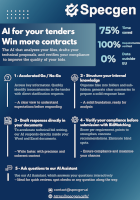
Specgen is a French artificial intelligence platform for complex technical tenders, with one solution for bidders and another for buyers. It analyzes the tender dossier, extracts and structures requirements, searches internal knowledge that the user is authorized to access, assists with drafting in existing documents, and checks the compliance of the response. It can be deployed on-premises or air-gapped, with no external AI API and no outbound data flows, for sensitive sectors: industry, energy, defense, sovereign functions, operators of vital importance (OIV).
In an industrial tender, this approach makes it possible to structure the requirements arising from the CCTP and the other documents, to search for authorized internal knowledge, and to check its coverage in the response. The page AI for industry and engineering tenders presents the uses dedicated to the sector. For the role of AI in this step, see also our article on theAI analysis of tender requirements, and for the final verification, our article on the bid compliance.
A a demonstration can be arranged on a representative file from your industrial calls for tenders.
Key takeaways
A technical CCTP must be converted into actionable requirements rather than summarized chapter by chapter. In an industrial tender, the difficulty often comes from prescriptions spread across several documents and several disciplines. The requirements matrix maintains the link between the customer’s request, its source, the internal owner, and the response provided. The final review then makes it possible to check that the requested commitments are indeed covered before the bid is submitted.
Sources
Order of 30 March 2021 approving the General Administrative Clauses for industrial public contracts (CCAG-MI), Article 2
French Public Procurement Code, Article R2111-4
French Public Procurement Code, Article L2152-2 (definition of an irregular tender), on Légifrance.
Legal Affairs Directorate, fact sheet “Defining the need” (2019)
 Specgen