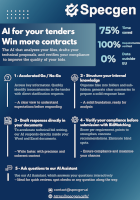
AI analysis of the requirements of an RFP
5 January 2025
QualitySecurity Sourced §4.2 5
Regulatory Sourced §6.1 4
Security Sourced §7.3 2
RSE Sourced §9 4
Drafting a winning tender response begins with a crucial step: identifying and carefully analyzing the individual requirements set out in the tender documentation. This process not only ensures that your submission meets the client’s expectations, but also demonstrates a deep understanding of their needs, strengthening confidence in your ability to deliver. In a competitive landscape where precision and clarity are paramount, addressing each requirement effectively can make the difference between success and failure.
Why identifying and analyzing requirements are important
Tender documents are often dense and complex, containing numerous specifications, criteria, and guidelines that must be handled meticulously. The omission or misinterpretation of a single requirement can lead to:
- Non-compliance: submissions that do not meet all mandatory requirements are often disqualified outright.
- Reduced competitiveness: a response that does not fully match the client’s needs may be given a lower score.
- Waste of resources: investing time and effort in a response that is missing key elements can lead to missed opportunities.
By identifying and analyzing each requirement, organizations can:
- Ensure alignment: develop responses that directly address the client’s priorities.
- Save time: focus on the most critical aspects of the tender.
- Improve quality: develop a complete and compelling proposal that stands out.
The role of AI in needs analysis
Artificial intelligence (AI) has revolutionized the way companies approach tender documentation. Unlike traditional manual analysis, AI offers a faster and more reliable solution for identifying and interpreting requirements.
Key benefits of AI:
- Speed: AI can process large volumes of text in a fraction of the time it would take a human, enabling faster turnaround times.
- Accuracy: by eliminating human error, AI ensures that no requirement is overlooked or misunderstood.
- Consistency: AI applies the same standards to all documents, thereby ensuring consistency in the analysis.
- Scalability: AI can handle multiple tenders simultaneously, making it ideal for organizations managing high volumes.
Specgen : the future of requirements analysis
One of the most advanced tools in this field is Specgen, a model specifically trained for requirements identification and analysis. Specgen leverages state-of-the-art natural language processing (NLP) to deliver unmatched accuracy and efficiency.
Why choose Specgen ?
- Purpose-built: Specgen is designed with tender documents in mind, ensuring an understanding of the nuances and complexities of these documents.
- Reliability: its training on diverse datasets enables it to recognize and interpret requirements across all sectors and industries.
- User-friendly: Specgen integrates seamlessly into existing workflows, providing actionable insights that save time and improve decision-making.
By using Specgen, organizations can transform their approach to tenders. The model’s ability to identify, extract, and prioritize requirements ensures that responses are not only compliant, but also strategically aligned with the client’s objectives.
Conclusion
In the competitive world of tenders, identifying and analyzing each individual requirement is a non-negotiable step toward crafting a winning response. While this task has traditionally been time-consuming and prone to errors, AI has become a game changer. Tools like Specgen offer an efficient, reliable, and scalable solution for requirements analysis, enabling organizations to deliver high-quality tender responses with confidence.
As the tendering process continues to evolve, leveraging AI-based tools like Specgen will be essential to stay ahead of the competition. By adopting this technology, companies can not only meet customer expectations, but exceed them, paving the way for long-term relationships.
 Specgen