Your expertise makes the difference. Its scope remains controlled.
Prepare your defense bids and your responses to naval tenders using authorized knowledge. Analyze, draft, and verify within your infrastructure, On-Premises or Air-Gapped, with traceable sources and access rights applied to processing.
Bid management, program managers, and security · Defense manufacturers, equipment suppliers, and naval contractors
The selection of knowledge for the offer is made within the authorized scope.
Unauthorized knowledge is not used to generate the answer.
Document control supports the review before submission.
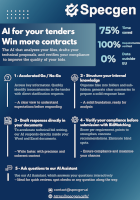
Explanatory diagram · Fictional example, with no customer data.
A solution tailored to the way you work.
The right knowledge
Teams contribute to several programs with different document access rights.
Your expertise mobilized
Responses reuse methods, references, and technical elements specific to your activity.
Equipment and support
An offer for embedded equipment or operational maintenance combines performance, interventions, and timelines.
Processing on your premises
The deployment must fit within the security perimeter defined by your organization.
A documented response, a controlled review.
For a naval support or equipment tender, BidMatching aligns the customer’s expectations with the proposed responses. The review team has the justifications to assess resources, performance and timelines.
Your tendering AI.
In your environment.
A three-month discovery is also possible On-Premise or Air-Gapped , after installation in your environment. Operation without an outbound connection can then be evaluated with your technical teams.
More time for expertise and decision-making.
Build on the methods and references accessible to the response team.
Link requirements analysis, drafting, and verification in a single workflow.
The models, documents, and checks run in the selected environment.
Questions to review for your project.
Access rights govern the knowledge that can be used by the processing. The selection of sources for an offer falls within this scope.
Specgen runs in an air-gapped environment. Models and processing are local; updates are delivered as packages for validation and installation by authorized teams.
See what Specgen brings to your offers.
Let’s discuss your use cases with the people involved in your project. A one-hour video demo, with no prior preparation.
Request a demoAn old file can be used as supporting material under an NDA. The AI results are presented back to you on a timeline agreed based on the teams’ availability.
The answers to move forward.
How does Specgen apply rights by program?
Accessible knowledge is restricted according to rights and program. The scope applies to search, drafting, and review.
Does Specgen detect copy-and-paste from another program?
Not in an offer that has already been drafted. The compartmentalization presented concerns the sources accessible to the processing, and does not constitute a general detection of the origin of an imported text.
How to use Specgen for a naval tender?
For an onboard system or a support service, Specgen extracts requirements from the documents provided, prepares a response from authorized knowledge, and compares the offer against the customer’s expectations.
How does Air-Gapped deployment work?
The models and the analysis, search, drafting, and review processes run in the isolated network, with no Internet connection, no external AI API, and no outbound telemetry.
Is Specgen accredited for any classified document?
No general certification is claimed. Specgen is designed for Restricted Distribution environments; its use depends on your organization’s scope and authorizations. Technical elements are available to support the deployment review.
Can we try Specgen for three months on our infrastructure?
Yes. The three-month discovery can be carried out On-Premise or Air-Gapped, after installation in your environment. Discovery on servers in France is also possible for non-sensitive cases suited to this framework.
How can we verify the sources of the AI’s results?
Requirements, drafted passages, and assessments are linked to their documentary sources. Specgen flags insufficient information; your teams review the supporting evidence and validate the results.
 Specgen