Because AI is not neutral. It affects data control, technological dependence, and therefore the ability of French companies to remain sovereign… while becoming more efficient.
It is in this context that Specgen was presented and selected at Bercy to represent an approach to sovereign AI applied to a particularly sensitive topic: tenders.
AI: a lever for competitiveness… provided we keep control
French competitiveness is under pressure: competitive intensity, regulatory requirements, faster sales cycles, pressure on margins.
In many sectors, AI can make the difference, but not just any way.
Useful AI in the enterprise must be:
• Practical: it acts on real processes, not on demonstrations.
• Operational: it integrates into working methods and on-the-ground constraints.
• Reliable: it improves the quality of deliverables, not just speed.
• Sovereign: it does not expose strategic data to uncontrolled risks.
This is where the choice of tools becomes decisive. An AI tool can speed up a process… while also creating new risks (information leakage, vendor lock-in, lack of traceability, uncertainty about how data is used, etc.).
Why tenders are at the heart of sovereignty challenges
Calls for tenders are not a process “like any other”. They concentrate, within a single document flow, a large part of an organization’s strategic value.
A tender dossier may contain:
• sensitive technical and industrial information,
• pricing and margin elements,
• IT architectures, security policies, project data,
• regulatory and contractual requirements, or requirements related to critical infrastructure,
• differentiating elements (methods, organization, partners).
In other words: it’s a concentrated dose of competitive intelligence.
Using “public” AI or AI that isn’t sufficiently controlled on these documents can become a point of vulnerability. And at scale, these vulnerabilities add up. That’s precisely why digital sovereignty is becoming a competitiveness issue: a high-performing company must also be a company that keeps control of its data and its decisions.
Sovereign AI applied to tenders: the Specgen approach
Specgen was designed to meet a simple but critical need: speed up and make the processing of calls for tenders more reliable, without compromising confidentiality.
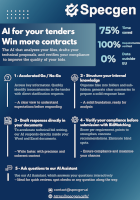
Our AI enables, among other things:
• the analysis of complex dossiers,
• extraction and structuring of requirements,
• compliance verification,
• comparing bids or response elements,
• improving the quality and consistency of deliverables.
A secure AI, 100% fFrench
In a market where AI solutions are sometimes opaque, Specgen emphasizes control: control over processing, access, hosting, and data.
It is this approach that led Specgen to be presented and selected at Bercy, as an illustration of AI applied to a sensitive, concrete, and strategic use case: sovereign tenders.
Buyers and bidders: the same need, a shared objective
For Buyers
Procurement and project teams have to deal with: large volumes of documents, a dense requirements grid, heterogeneous bids, tight time constraints, and an obligation for traceability and rigor.
AI becomes a co-pilot to: speed up analysis, make comparisons more objective, secure evaluation, and improve the quality of decisions.
For bidders
On the response side, the pressure is constant: respond well, without errors, and with a clear and compliant proposal.
AI helps to: quickly identify critical requirements, structure a response, check compliance point by point, reduce omissions and inconsistencies, save time without sacrificing quality.
In both cases, the desired outcome is the same: greater competitiveness, higher quality, and less risk.
French cloud or on-premises: you choose the level of sovereignty
Sovereignty is not a slogan: it’s an architectural choice.
With Specgen, you have a choice:
• French cloud hosting, for rapid implementation,
• On-premises deployment, to keep processing within your environment.
In both cases, the goal is the same: increase operational performance, without outsourcing what must remain under control.
How to choose an AI tool without weakening your company?
Before adopting AI for sensitive processes (such as tenders), here are 6 simple questions to ask yourself:
1. Where are the data processed and stored?
2. Who can access it? (permissions, authentication, traceability)
3. Does the tool use your data to train its models?
4. Can it be deployed on-premises if necessary?
5. Does the tool integrate with your workflows (Word/Excel/PDF)?
6. Is the result explainable and verifiable? (reliability, compliance, sources)
Competitiveness doesn’t come only from “saving time”. It comes from saving time + improving quality + managing risk.
Conclusion: competitiveness and sovereignty go hand in hand
AI is a major opportunity for French companies. But the question isn’t just “how to go faster”.
The question is: how do we become more effective without losing control?
Tenders are an excellent litmus test—a space where AI delivers immediate value, but where sovereignty is non-negotiable.
That is Specgen’s purpose: secure, sovereign, and operational AI, to improve competitiveness and quality, without compromising confidentiality.
 Specgen