Securing processes in the age of AI: why automation without a framework is a risk, and how to keep humans at the heart of decision-making
Artificial intelligence is now widely presented as a performance accelerator. It promises to save time, reduce costs, and automate complex tasks. Yet as companies integrate it into their processes, a central question emerges: who is really driving the work? The human, or the tool?The DGSI’s recent note on the risks linked to the use of AI in companies does not only highlight data security issues. More broadly, it points to a loss of control: loss of control over information, over decisions, but also over the processes themselves. This warning should be understood as a strong signal: poorly integrated AI does not only weaken confidentiality; it weakens internal organization, the quality of deliverables, and, ultimately, a company’s ability to own and justify its choices.
In many current solutions, AI is conceived as an autonomous engine capable of producing “from nothing,” from a blank page. This approach, appealing at first glance, nevertheless raises a fundamental problem: it erases the business structure, expertise, and collective intelligence that constitute the company’s true value.
The blank page: a dangerous illusion for business processes
A company never starts from a blank page. A process exists because it meets constraints (regulatory, contractual, operational), because it reflects accumulated know-how, and because it relies on proven methods. When an AI tool is designed to “invent” freely, it positions itself upstream of this structure instead of integrating into it. AI is no longer an assistant: it becomes the implicit starting point for the decision, and the human slips into a proofreader’s role.
That is precisely what the DGSI is referring to when it speaks of a loss of control. The user ends up validating reasoning they did not fully construct. And the more this pattern repeats, the more it transforms the relationship to expertise: AI no longer supports human skill; it begins to replace it, often silently.
When time optimization destroys process control
Most AI tools on the market sell themselves on a simple argument: going faster. Writing faster, analyzing faster, deciding faster. But a business process is not a simple production line: it is a system of responsibilities. When an AI structures information on its own, rephrases without an explicit framework, prioritizes without business logic, or offers conclusions without traceability, it creates a gray area in the reasoning.
At that point, the risk is not only error. It is the inability to explain why a result was produced, to demonstrate that a method was applied correctly, or to justify a decision to a client, an auditor, a judge, or a regulator. In the long term, this type of integration also fuels cognitive dependence: teams end up relying on the tool by reflex, which weakens critical thinking and gradually impoverishes internal know-how.
AI must adapt to processes, not the other way around
One principle should guide any serious integration of AI: it’s not the process that should adapt to AI; it’s AI that must adapt to the process. AI that is truly secure from an organizational standpoint is not autonomous AI. It is AI that is guided, instrumented, and governed.
In practical terms, this means the company defines the framework before deploying the tool: which steps must remain human, when AI intervenes, according to which rules, with what level of validation, and with what traceability. This is not a luxury; it is a condition for control. The more an AI is integrated into a critical process, the more it must be constrained by clear rules, to prevent it from becoming an implicit decision engine.
An inevitable divide between companies
In the short term, all companies will use AI. The difference will be decided elsewhere. On one side, those that have integrated AI into structured, documented, and governed processes will gain lasting performance. On the other, those that have let AI dictate their practices in the name of speed will gradually lose control of their methods, their internal coherence, and their analytical capacity.
AI can make you more efficient. But it can also make you more passive, more dependent, and intellectually more fragile if it is used as a shortcut. The gap will emerge between those who use AI as a process-engineering tool and those who use it as a substitute for reasoning.
Tenders: a field where process control is critical
Tenders are an emblematic use case, because they concentrate high strategic value for all parties. For the buyer, it involves formalizing a need, defining criteria, ensuring the fairness of a procedure, and making decisions with legal, financial, and operational implications. For the bidder, the response reveals a commercial strategy, an internal organization, production or service-delivery methods, as well as differentiating elements that often constitute the company’s competitive advantage.
In this context, an AI that “goes off in all directions,” produces freely, or offers conclusions that cannot be explained is a risk. It shifts a standardized, defensible process into an opaque space. Conversely, a guided AI can be extremely powerful: it speeds up document analysis, strengthens rigor, and secures quality, without ever substituting for human expertise.
How Specgen applies truly controlled AI to tenders
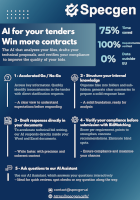
It is precisely to avoid these pitfalls that Specgen was designed. Our approach is based on a simple idea: AI must never be the source of the reasoning; it must be its accelerator. In other words, the tool steps in where it is relevant—time-consuming tasks, large-scale analysis, structuring and verification—while keeping teams at the center of decisions.
On the bidder side, Specgen makes it possible to analyze the tender documents, identify requirements, structure the response, and speed up drafting using approved content. What matters is that the strategy remains human: the outline, positioning, trade-offs, narrative, and evidence rely on the teams’ expertise. The AI is there to save time and reduce omissions, notably thanks to compliance analysis that highlights gaps and areas to strengthen.
On the buyer side, the challenge is to have an analysis that is consistent, traceable, and defensible. Specgen helps structure the reading of responses, make compliance more objective, and highlight differences, without blind automation. The final decision always remains the buyer’s, but it is better informed, more consistent, and easier to justify.
This positioning is deliberate: Specgen does not seek to “replace” the process, but to equip it. The user initiates, guides, validates. The AI suggests, speeds up, checks. It does not decide on its own. It does not create a parallel logic. It strengthens the rigor of an existing framework.
Choosing your AI means choosing your organizational model
Not all AI carries the same vision of work. Some prioritize absolute speed, even if it means producing results that are hard to explain. Others prioritize control: they fit into existing methods, respect validation steps, and make the user more effective without diminishing them.
In a context where institutions are warning about the loss of control caused by certain practices, choosing an AI is no longer simply about comparing features. It is a governance choice, a responsibility choice and, in some sectors, a strategic choice for competitiveness.
Conclusion
AI can profoundly transform businesses, provided it does not transform the way they take responsibility for their decisions. Useful AI is AI that respects business structures, strengthens human expertise, secures processes, and clarifies accountability. Only under these conditions does it become a lever for sustainable performance, rather than a factor that causes a loss of control.
 Specgen