A tender is not a free-form creativity contest: it is a strict framework, defined by requirements, criteria, and constraints, sometimes explicit, sometimes implicit. Compliance makes it possible to verify, point by point, that this framework is respected, without approximation. And yet, in practice, it is still largely handled in a craft-based way, with a real risk: missing a determining element, not for lack of competence, but for lack of time or visibility.
A shared requirement: buyers and bidders are exposed in the same way
On the buyer side, compliance is the foundation of any fair decision. Without rigorous analysis, it becomes difficult to ensure that bids are compared consistently and that minimum requirements are met. The risk is then twofold: rejecting a candidate for the wrong reasons, or selecting an offer that only partially meets the need without this being clearly apparent. In some environments, public and private alike, the stakes are also legal: in the event of a challenge, compliance is a central element of justification, because it proves that the criteria were applied objectively and in a traceable manner.
On the bidder side, compliance is just as strategic, but is often experienced as a constraint. In reality, it directly determines access to the competition. A bid can be excellent in substance and still be disqualified if it does not meet a structuring requirement. More subtle still: partial coverage or an imprecise answer can penalize a bid without teams clearly understanding why. Without a detailed analysis, the bidder is left in the dark, and it becomes difficult to improve: did we lose on price, on technical merit… or simply because a key point was poorly addressed?
Compliance is therefore a risk-mitigation tool, but also a learning tool.
The problem: document complexity that makes human error inevitable
A tender often represents a large volume of documents, with requirements scattered across multiple attachments, sometimes phrased indirectly.
Analyzing them manually, exhaustively, requires constant focus and availability that teams do not always have, especially when deadlines are tight.
Even with experienced team members, compliance analysis remains exposed to very human limitations: cognitive fatigue, oversights, partial interpretations, or simply schedule pressure. This is not a problem of team quality, but a structural phenomenon: humans are excellent at understanding context, arbitrating, and deciding. They are less reliable when it comes to identifying and verifying, without exception, dozens or hundreds of requirements spread across a large number of pages.
It is precisely at this point that artificial intelligence delivers decisive value.
AI: a practical lever to reduce errors and make the process more reliable
Applied to compliance, AI does not replace human expertise. It secures it. Its role is not to “decide” in place of teams, but to ensure exhaustive coverage, prevent omissions, and provide a structured reading of requirements. Where the human brain can naturally lose vigilance page after page, AI can process large volumes with remarkable consistency.
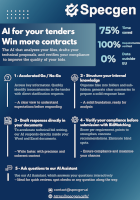
When it is well designed and integrated into the process, AI can identify requirements, structure them, link them to response elements, and then highlight risk areas. It acts like a methodological safety net: it doesn’t just save time, it improves the reliability of the approach. And in a tender, reliability is a competitive advantage.
Compliance as a tool for progress: understand, improve, refine
Compliance is not only about “avoiding disqualification.” It can become a real performance lever. By making requirements coverage objective, you get a clear diagnosis: what is solid, what is fragile, what is missing, what needs to be clarified. This visibility changes the relationship to the process.
For a bidder, this makes it possible to correct a response before submission, spot the points that weaken the score, and embed a continuous improvement approach.
For a buyer, this makes the evaluation fairer, more consistent, and easier to defend: you know precisely why one offer meets the requirements better than another, on which points, and with what level of coverage.
In both cases, compliance turns the tender into a more rational, more transparent, and more controlled process.
The Specgen case: making compliance a pillar, not an option
At Specgen, compliance is not treated as a secondary module. It is part of the core of the platform, because that is often where decisive gaps are determined. Our compliance analysis module, BidMatching™, was designed around a simple objective: reduce errors, make analysis more reliable, and make requirements coverage readable, traceable, and actionable.
BidMatching™ makes it possible to extract and structure requirements from tender documents, then compare them with the content of the bid or the analyzed elements. The goal is not to produce an automatic decision, but to provide a robust analysis basis: visualize gaps, identify missing items, understand what is actually covered and what is not. The user remains in control. AI provides an exhaustive and consistent reading, where manual analysis can, despite all efforts, miss elements.
On the bidder side, this translates into an ability to secure a response before submission, but also to understand objectively why an offer performed less well.
On the buyer side, this results in a more consistent, more transparent, and more easily justifiable evaluation, because it is based on a structured and reproducible analysis.
Conclusion
In a tender, compliance is the bedrock of quality. Neglecting it means accepting that a degree of chance, or oversight, will decide the outcome of an otherwise strategic process. Conversely, incorporating AI-assisted compliance analysis is a simple choice: reduce human error, make evaluation more reliable, and professionalize the approach for the long term.
Compliance is not an administrative constraint. It is a lever for rigor and progress. And when it becomes measurable, structured, and actionable, it turns the tender into a fairer, higher-performing, and better-controlled process, for buyers as well as bidders.
 Specgen